Blake Smith is an independent SEO consultant based on the NSW Central Coast who works directly with businesses, marketing teams, developers and agencies across Australia. The practice is built around a direct, senior-level consulting model rather than the account management layers common in agencies. Having worked in digital marketing since 2012 and specialised in SEO for more than a decade, Smith frames the work around a simple idea: understand what is limiting search performance before choosing what to fix.
What the consulting service actually covers
The service list is broad but not unusual for an SEO consultant. Where it becomes more distinctive is in the emphasis on diagnosis and priorities over activity. The site describes six main areas:
| Service area | What the engagement involves |
|---|---|
| SEO audits and strategy | Reviewing performance against competitors, identifying constraints, and producing a prioritised plan |
| Technical SEO | Crawling, rendering, indexation, migrations, redirects, canonicals, site architecture and Core Web Vitals |
| On-page SEO and content | Keyword and intent mapping, internal linking, content improvement, page consolidation and URL ownership |
| Digital PR and authority | Relevant authority building, expert commentary, brand mentions and link acquisition |
| Ecommerce SEO | Shopify, WooCommerce and other platforms, covering category architecture, technical SEO, content and authority |
| AI search and generative SEO | Visibility in ChatGPT, Gemini, Perplexity, Claude and Google AI, including how a brand is understood, retrieved, cited and recommended |
Local SEO also appears throughout, especially on the city-specific pages, where Google Business Profiles, Local Pack visibility and location page decisions are explained in context.
The diagnosis-first approach is the real offer
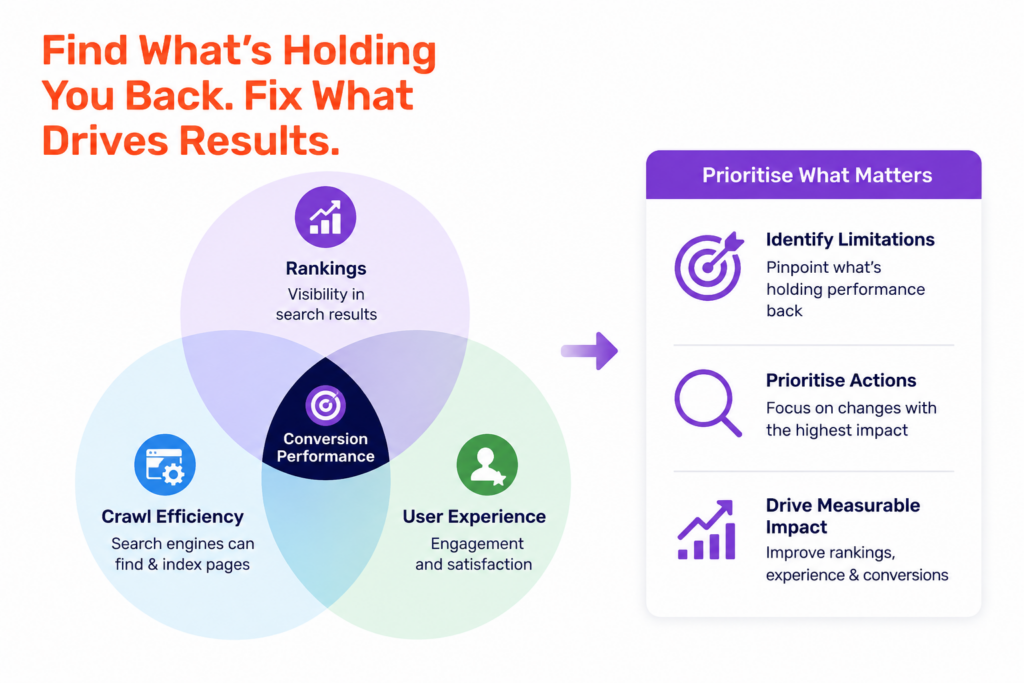
The most consistent theme across the site is the refusal to start with a template. Smith describes a four-stage process: establish commercial goals, diagnose the constraint, prioritise what should change, then implement, measure and adjust. That sequence matters because it changes the nature of the deliverable. Instead of producing a long list of technical issues, the consultant is supposed to explain which issues are materially suppressing visibility and why.
That position shows up clearly on the audit page. It argues that many SEO audits are effectively raw tool exports with hundreds of warnings and no explanation of what hurts visibility first. The described audit process moves through crawling and indexation, technical assessment, Core Web Vitals, search intent and content, then AI visibility analysis. The point is not finding problems. The point is understanding which problems constrain commercial outcomes.
AI search is treated as an extension, not a replacement
The site does not present AI search optimisation as a separate discipline that replaces traditional SEO. Instead, it treats AI visibility as a related layer on top of existing technical and content work. The details are telling: AI search questions include machine comprehension, retrievable passages, third-party corroboration, schema, semantic clarity and answer extraction. Those are not separate from good content and architecture; they depend on them.
The broader argument on the site is that AI search changes how people discover and evaluate businesses, but the web underneath still matters. A business still needs usable content, sound architecture and independent sources that corroborate who it is. The service aims to work across Google and AI systems because the underlying signals overlap heavily.
The city pages reveal stronger local thinking than most templates
One thing that separates this site from generic SEO consultant pages is the city-specific content. The Canberra, Melbourne, Brisbane, Perth, Central Coast and Gold Coast pages do not simply swap location names. They discuss how local search behaves differently in each market. Canberra’s town centre structure and government buyers create one set of priorities. Perth’s long, narrow geography and B2B buyers outside WA create another. Brisbane’s unusually large council area and river-based local identity matter for Maps visibility. Melbourne’s employment clusters outside the CBD change where demand actually sits.
Those insights are not just rhetorical. They tie directly to practical decisions, such as whether separate location pages are justified, how far Google Business Profile visibility can reasonably reach, and when organic pages must carry wider geographic reach because Google Maps cannot. A business owner reading this gets a better explanation of local SEO trade-offs than from a consultant who treats every city the same.
Engagement terms and pricing are not published
This is where the research hits a clear boundary. The site does not publish hourly rates, project fees, package prices or billing periods. Engagement shape is described loosely: a one-off diagnosis, a strategy, or ongoing support while changes are implemented. Prospective clients are directed to book a free consultation or describe their project.
That lack of pricing is not necessarily a criticism. In consulting, scope often changes based on the problem. But it does mean a buyer cannot compare cost without making contact, and should treat the consultation step as the point where scope, cost and fit are established.
Who is likely to get the most value
The service is aimed at Australian businesses that need senior SEO expertise without necessarily retaining a full agency. The site names small businesses, ecommerce operators, SaaS companies and larger websites as examples. It also positions the consultant as a useful resource for marketing teams that need specialist direction, companies planning redesigns or migrations, and agencies looking for a second opinion.
The model is likely most useful when a business already has people who can implement changes but lacks someone senior enough to set the right priorities. In those cases, paying for diagnosis and strategy can be more efficient than buying another production layer. For businesses that need substantial content, development and outreach capacity at once, the site itself concedes an agency may be the better fit.
What an independent buyer should keep in mind
Blake Smith's marketing material gives a coherent picture of a senior consultant who prizes diagnosis, prioritisation and practical implementation support. The local market knowledge is specific, and the AI search positioning is more practical than much industry commentary. That said, the evidence of results on the site is limited. It includes testimonials and a stated 247% increase in organic traffic for a national flooring brand, but those are self-reported and not independently verifiable from the collected pages. Pricing and engagement terms also remain unknown until direct contact.
For the right business, that trade-off may be acceptable. The stated process is designed to find the few changes that matter before committing to larger projects. Whether that process consistently delivers will depend on the consultant, but the positioning at least makes the working logic clear.